→
Insights
June 15, 2026
0 min
-

Parallax
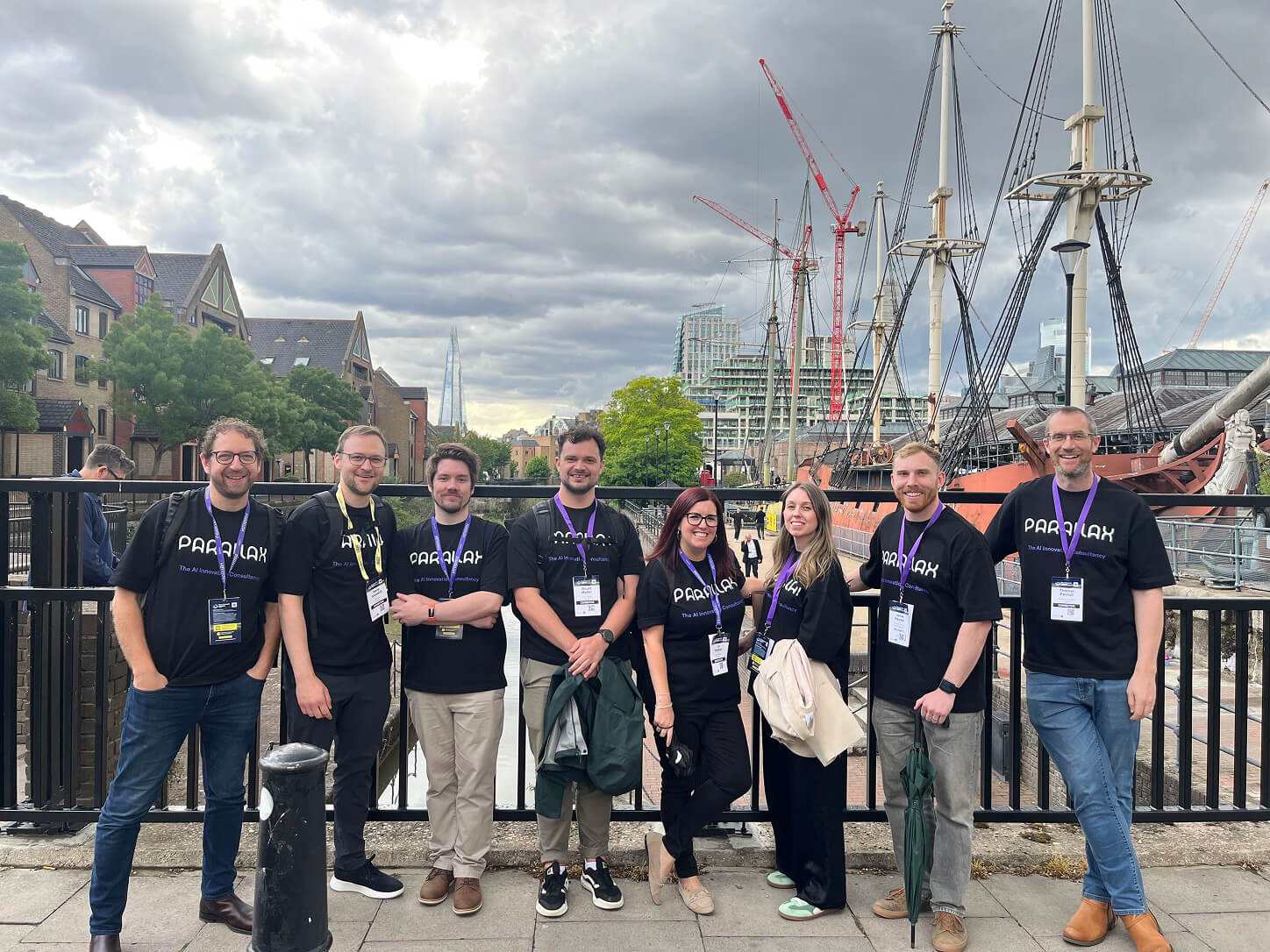
Last week, we spent two days at The AI Summit London speaking with technology leaders, transformation teams, product leaders and innovators from across finance, insurance, healthcare and enterprise technology.
What stood out to us wasn't a breakthrough model announcement or a new wave of AI hype. It was how much the conversation has matured.
Compared to last year, far more organisations are actively using AI. Most have moved beyond asking whether they should adopt it. The challenge they're now wrestling with is how to use it effectively, responsibly and at a scale that creates genuine business value.
In many ways, the discussions we heard reflected challenges we've been seeing with clients in our AI work for some time now.
The strongest signal from the summit was that organisations are very much ready to move from experimentation into execution - but they need guardrails and guidance to do so.
For the last two years, many businesses have been exploring AI through pilots, proofs of concept and internal productivity tools. Now, they're under pressure to demonstrate outcomes.
The technical barriers continue to fall. Building prototypes is faster and cheaper than ever, but what remains difficult is deciding where AI can create genuine value and how to deploy it in a way that people trust.
That conversation was visible across almost every industry represented at the event.
Financial services, insurance and healthcare organisations were particularly well represented, and while their use cases differed, the challenges were remarkably similar. Questions around governance, compliance, ownership and scalability appeared far more frequently than discussions about model performance.
We also noticed a growing recognition that simply providing employees with access to AI tools isn't a transformation strategy. Which was great to see, as we’ve been flying this flag for a while!
Many organisations have rolled out Copilot, Claude or similar platforms and encouraged teams to find their own use cases. While that can unlock experimentation, it often creates fragmented adoption, inconsistent outcomes and new operational risks.
As one of our team members observed during the event - asking people to automate parts of their jobs without providing the right frameworks, support and direction often sets teams up to struggle. There is a clear appetite to use AI, but success comes from embedding it into tools, workflows and products that solve real business problems.
The organisations making the most progress appear to be taking a more deliberate approach. They're focusing on clear use cases, thoughtful rollouts, strong governance, and solutions designed around outcomes - rather than technology for the sake of it.
Several themes were repeated throughout the summit, but governance was perhaps the most prevalent.
As organisations introduce GPTs, agents, automations and AI-powered workflows across multiple departments, the challenge becomes understanding what's been built, who owns it, how it's being monitored and (crucially) whether it's delivering value.
Many businesses aren't struggling because they lack AI capability. They're struggling because AI is appearing faster than their operating models can adapt.
Conversations around AI inventories, ownership models, testing frameworks, auditability and usage monitoring were everywhere. The idea of AI Operations or AgentOps is rapidly becoming a practical requirement rather than a future consideration.
We also heard a great deal about trust.
As access to leading AI models becomes increasingly widespread, organisations are looking elsewhere for competitive advantage, often seeking out teams like ours for consultancy and support. In regulated environments especially - transparency, governance and explainability are becoming critical factors in adoption decisions and stakeholder buy-in.
But another recurring theme was the growing importance of human judgement.
While AI continues to improve at generating outputs, people remain responsible for deciding which outputs matter, which should be acted upon and which create meaningful business value. Product thinking, domain expertise and decision-making were consistently highlighted as capabilities that will become more important, not less.
One speaker made a point that resonated with us: “the bottleneck has moved from building to deciding”.
That certainly reflects what we're seeing in practice. Most organisations have no shortage of ideas, the difficulty they face is identifying the opportunities that genuinely deserve investment, and having the discipline to focus on those that will create measurable impact.
The biggest takeaway from the summit? AI is becoming less of a technology challenge and more of an organisational one.
Most businesses already have access to powerful models, tools and platforms. The differentiator is no longer whether they can experiment with AI. It's whether they can operationalise it. Baked into their systems and processes, properly.
That requires clear objectives, strong ownership, robust governance and a deep understanding of the problem you're trying to solve.
Many of the conversations we had around this reflected work we've been doing with clients over the last few years.
The organisations seeing the greatest success tend to start by identifying where AI can create measurable value, rather than beginning with the technology itself. That means understanding existing processes, data, systems and user needs before deciding how AI should be applied.
From there, the focus shifts to rapid delivery and learning. That’s exactly how we work with our clients. Our standard approach is to iterate and deliver every step of the way. Getting solutions into the hands of users quickly allows organisations to gather real feedback, validate assumptions and understand where value is actually being created. The most successful AI initiatives aren't built in isolation. They're shaped through iteration, testing and continuous refinement.
Perhaps most importantly, they plan for adoption from day one.
One of the clearest messages from the summit was that AI doesn't create transformation on its own. People do. The organisations making progress are investing as much energy into trust, governance and ways of working as they are into models and platforms.
The businesses creating lasting value from AI are treating it as a product and transformation challenge, not simply a tooling exercise. They're building capabilities that can scale, evolve and earn trust over time.
Based on the conversations we had across the two days, that's where the next phase of competitive advantage will be created.
And, judging by the themes that dominated this year's summit, it's where many organisations are now turning their attention!
If your organisation is struggling to move AI beyond pilots and into production, while keeping adoption up and guardrails secure - we’d be interested to hear what challenges you’re encountering. Many of the conversations we had at the summit are the kinds of questions and queries we hear from our clients everyday, so we’re well placed to offer strategic and informed advice.
Drop us a message, let’s talk it through.