→
Events
December 10, 2025
0 min
-

Sophie Fletcher
Commercial Director
We’re fortunate to work alongside some of the sharpest minds in technology, and we make it a priority to bring people together to share how innovation is really being applied inside major organisations.
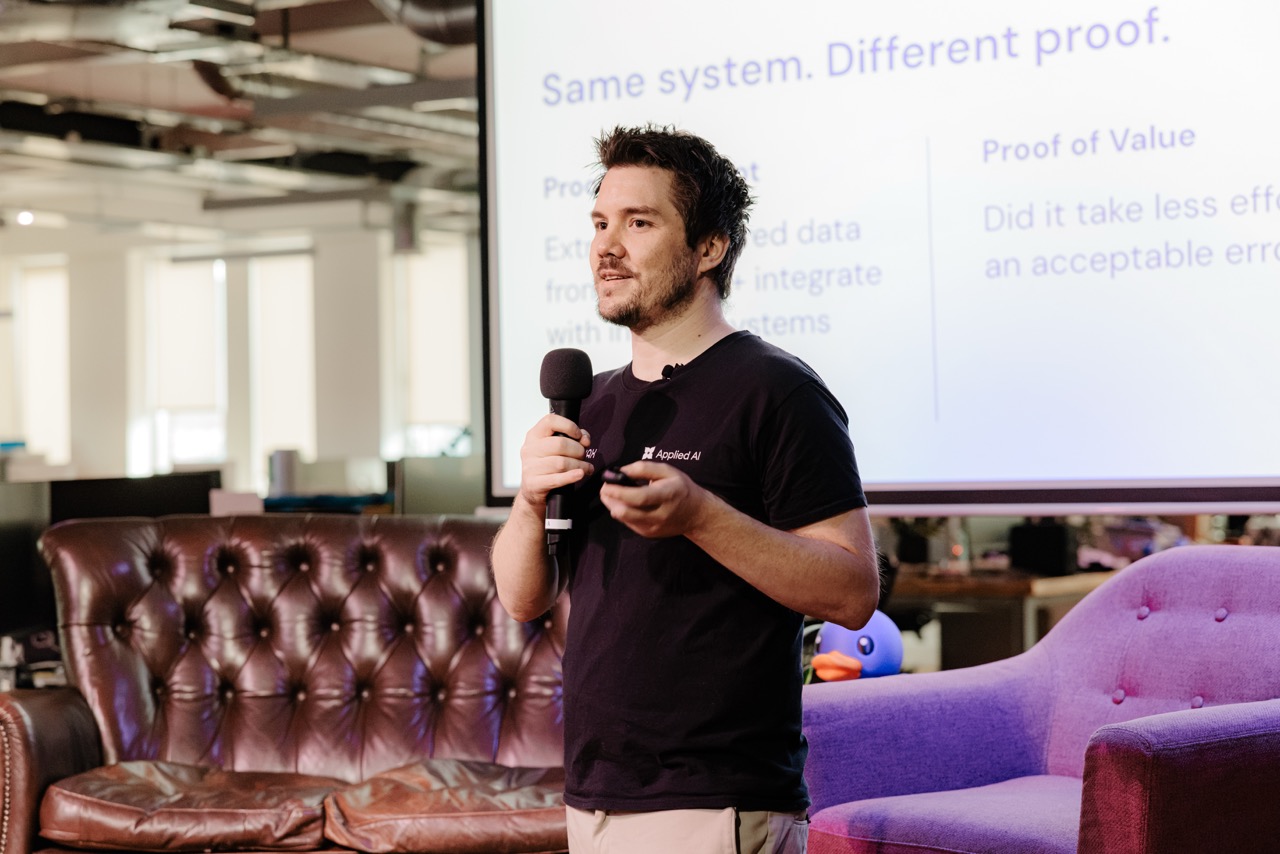
For our final executive AI roundtable of 2025, we headed to Grainger & Co. in Chelsea, and brought together a small group of senior leaders to explore one of the most pressing themes we’re hearing across the industry: how to take AI from proof-of-concept to production at scale.
Chaired by our own Dario and James, the conversation brought together leaders from global enterprises across banking, elite sport and beyond. What followed was a candid discussion about what’s working, what’s not, and what’s coming next.
Here's a few of the provocation points we expect to see dominate 2026:
AI needs to be framed as a revenue driver - not a cost-cutting exercise. While CFOs are still calibrating how to value AI, private equity remains bullish because AI-driven capability is tangible and sellable. And if we are in a bubble? History tells us that bubbles don’t invalidate the underlying technology.
Some of the world’s largest institutions have centuries of processes behind them. AI is proving its worth by untangling legacy systems and liberating humans from the repetitive, manual work that has slowed innovation for decades.
With build speed no longer the bottleneck, deciding what to build matters more than ever. Often, the people closest to the problem - not developers - hold the clearest answers. Despite continued demand for “everything to everyone” chatbots, part of our job as an industry is to educate teams on what actually moves the needle.
AI as a decision-accelerator is powerful, but recent legal cases remind us there are domains where AI should advise - not decide.
You cannot over-invest in data. With volumes growing exponentially, AI is the only viable way to rationalise and leverage it. But data quality, access and trust remain the biggest blockers to adoption for many organisations.
Fear and misunderstanding still exist within workforces, even as AI creates entirely new roles: product managers, AI-native engineers, prompt specialists and more. Externally, human psychology continues to shape adoption - from generational attitudes and ethical expectations to sustainability pressures and the right balance between frictionless and meaningful experiences.
If any of these topics sound familiar to you, please connect with us and ask us about our 2026 events programme.
-min.jpg)